

While analyzing data from the QRNG, I realized something was odd. After a few quick checks, I found out that I wasn’t correctly pushing all the bytes to the backend.
Data was indeed being pushed, but in a recent firmware change I chose to record not only the least-significant bit (LSB), but all the raw data coming from the radon decay detector. Why restrict data analysis to just one bit at the origin?
So I made the firmware modification, but I didn't adjust how often data was being pushed—leaving the schedule at once every 2 hours. As a result, the device buffer couldn’t hold the richer payload volume between transmissions, leading to a large amount of lost values for late analysis over a couple of months.
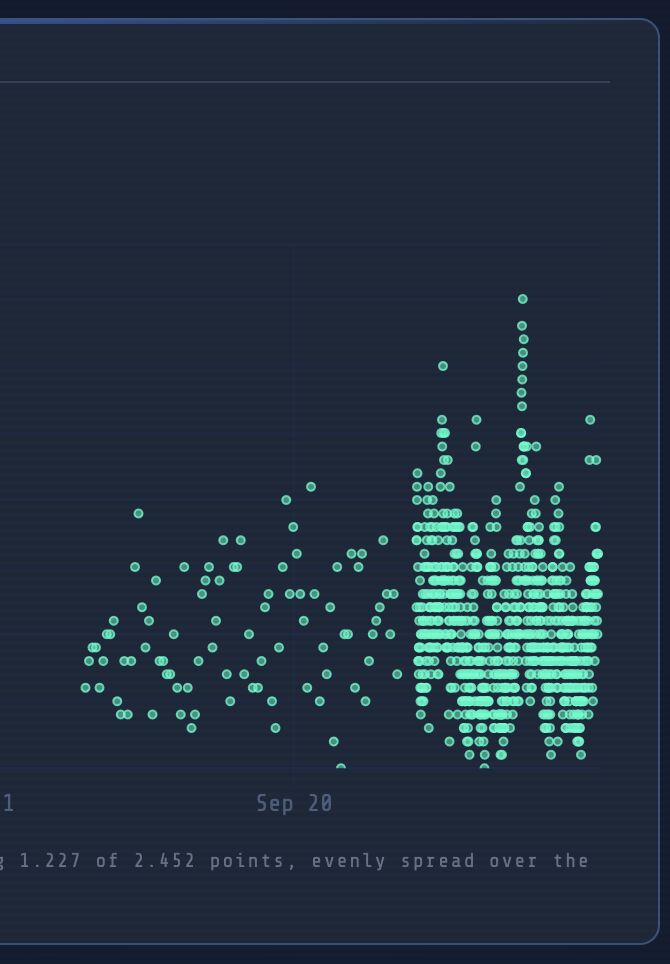
This new update fixes that pipeline, which can be seen in the plot above simply by observing the immediate jump in measurement density!
This is what happens when you move too quickly and miss key pipeline assumptions—a reminder of why steady, methodical verification matters in hardware engineering.
Intrinsic Sensor Bias Remains Healthy
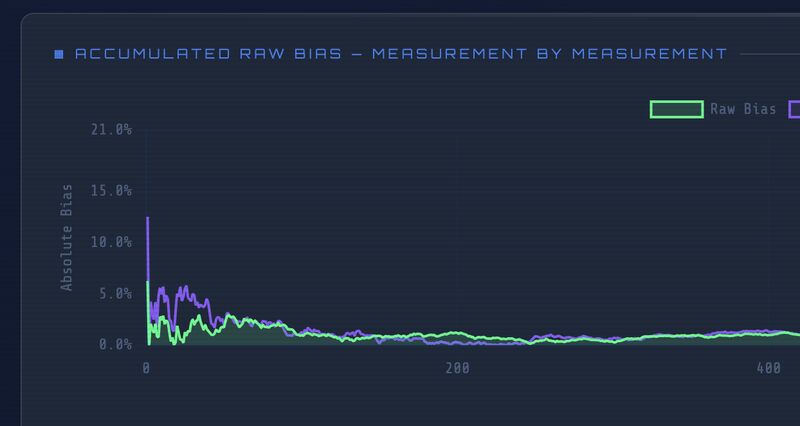
For those following the live status of the QRNGabri, the intrinsic physical bias of the device remains as healthy as always, stably converging around ~0.8% to 1.0% raw absolute bias across continuous measurements.
Interactive Quantum RNG Platform
You can inspect live streaming entropy from the Radon-222 alpha-decay detector and compare real-time convergence between raw, XOR-whitened, and Von Neumann debiased bitstreams on the live dashboard.
Launch Live QRNG Dashboard →Original discussion published on LinkedIn.